
12 Creative Formats Every DTC Brand Should Be Using in 2026
Most DTC brands are running three or four creative formats. Some are running fewer.
The same brands are wondering why creative fatigue is accelerating, why their cost per acquisition keeps climbing, and why scaling spend isn't scaling results.
The answer is almost always format range.
Meta's Andromeda system, which became core ad delivery infrastructure in 2025, organises creative into a hierarchical index based on similarity. Ads that look and feel the same get clustered together and compete for the same audiences. The more genuinely distinct your creative, the more audiences Andromeda can match it to.
An internal Meta test found that creative diversification drives 32% increased efficiency and 8% incremental reach compared to running similar creative. The brands seeing that kind of uplift aren't running more of the same. They're running more kinds of creative.
In this guide, we'll cover:
- Why format diversity drives performance
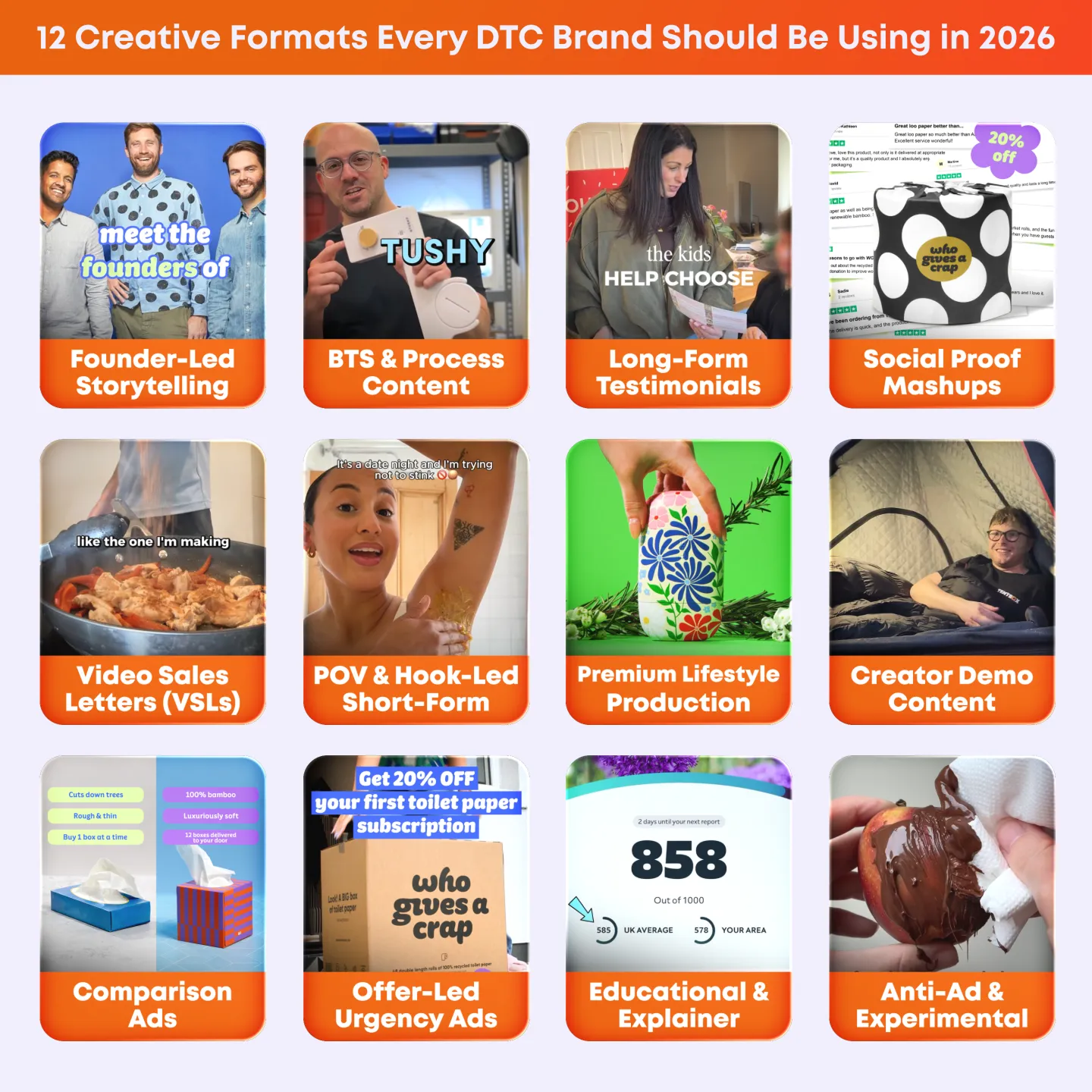
- The 12 creative formats every DTC brand should be using
- The most underused formats and why they're worth your attention
- How to apply them in practice
1. Why Format Diversity Drives Performance
When Meta evaluates your creative, it looks at visual composition, audio, copy, and narrative framing to decide which ads are conceptually similar.
Ads that share the same structure get indexed together, regardless of whether their copy differs.
A founder-led story, a customer testimonial, and a comparison ad are three different concepts. They reach different people, generate independent signal, and teach you different things about your audience.
Three static variations of the same lifestyle image are one concept, however many headline variants you run.
This is the practical case for format diversity. It directly determines how many audiences your ads can reach and how much signal your account generates.
Who Gives A Crap is a useful proof point. Working with Aura Ads across the UK, US, and Australia, the brand tested 375+ concepts spanning multiple formats, from polished brand assets to creator-led content to humour-driven experimental styles. The result: a 21% win rate, 70% growth in the UK market, and a 72% increase in Meta media spend globally. The diversity of format wasn't incidental to that result. It was the engine of it.
2. The 12 Creative Formats
1. Founder-Led Storytelling
What it is: The founder, or a senior team member, tells the story of why the product exists. The problem they encountered. The gap they saw. The solution they built.
Why it works: Founder content carries a different kind of trust to brand advertising. It's a personal account, and audiences are naturally more receptive to a person than a marketing message. It also answers the question most cold audiences have but never ask: why should I trust this brand?
Best for: Cold audiences encountering the brand for the first time. Premium products where provenance matters.
Funnel stage: Top of funnel.
2. Behind-the-Scenes / Process Content
What it is: An unfiltered look at how the product is made, sourced, tested, or developed.
Why it works: Transparency signals confidence. When a brand shows its process, audiences interpret that openness as proof there's nothing to hide. BTS content communicates quality without claiming it.
Best for: Brands where craftsmanship or sourcing is a genuine differentiator. Food, skincare, fashion, homeware.
Funnel stage: Top and mid-funnel.
3. Long-Form Customer Testimonials
What it is: A real customer talking at length about their experience. Not a five-second soundbite. A genuine account of the problem they had, how they found the product, and what changed.
Why it works: Social proof at depth. A customer describing a specific before-and-after experience is something a prospect can map onto their own situation in a way a star rating never achieves.
Best for: Products with a clear before-and-after story. Health, wellness, fitness, personal care.
Funnel stage: Mid-funnel.
4. Social Proof Mashups
What it is: A rapid compilation of customer reviews, UGC clips, comment screenshots, and reaction content, edited together with energy and rhythm.
Why it works: Volume of proof. A single testimonial says one person had a good experience. A mashup says everyone is talking about this. The cumulative effect creates a sense of momentum that a single proof point can't match.
Best for: Brands with substantial customer feedback to draw from. Audiences that are sceptical or comparison-shopping.
Funnel stage: Mid to bottom of funnel.
5. Video Sales Letters (VSLs)
What it is: A longer-form video, typically 60 seconds to three minutes, that walks through the problem, introduces the solution, proves it, and closes with an offer.
Why it works: For the right audience, depth converts better than brevity. A customer who is problem-aware and close to a decision will sit through a well-constructed three-minute argument. Most brands skip this format because it feels like too much. That's exactly why it works: it reaches people no other format is speaking to.
Best for: High-consideration purchases. Products where a 15-second ad can't carry the full argument.
Funnel stage: Mid to bottom of funnel.
6. POV / Hook-Led Short-Form
What it is: 15 to 30 seconds. An arresting opening, whether a question, a statement, or a provocation, that grabs attention in the first two seconds and delivers one sharp point.
Why it works: Pattern interruption. A hook that reads like organic content and makes someone stop scrolling can outperform polished production at a fraction of the cost. This is also the fastest format to test new angles and personas before committing to full production.
Best for: Cold audiences. Testing new narrative angles quickly.
Funnel stage: Top of funnel.
7. Premium Lifestyle Production
What it is: High-production video or photography placing the product in an aspirational context. Proper lighting, considered composition, professional casting.
Why it works: This format doesn't just sell the product. It sells the version of life the product belongs to. For premium brands, this is the creative that earns the price point and builds brand equity over time. It's the format that makes everything else more credible.
Best for: Premium DTC brands. Products where the aesthetic context is part of the value proposition.
Funnel stage: Top and mid-funnel.
8. Creator Demo Content
What it is: A creator, not a celebrity but a credible person in a relevant niche, who demonstrates the product in their natural environment. Their voice. Their reaction. Authentic setting.
Why it works: The mechanism here is trust transfer. A viewer who follows a creator has already decided that person has good taste, good judgement, or relevant experience. When that person recommends a product, some of that accumulated trust moves to the brand. A polished brand ad cannot manufacture that transfer. It has to be earned, and creators have already earned it with their audience.
The second reason is native feel. Creator content looks like the rest of the feed. It doesn't pattern-match to advertising, which means it bypasses the scroll reflex that standard ads trigger in experienced social media users. A viewer who would have scrolled past a produced brand ad will stop for a creator talking directly to camera in their kitchen.
The format is also one of the most efficient ways to reach new audience segments, because the creator's existing audience defines the targeting more precisely than any interest stack. For Who Gives A Crap, matching creators to the brand's purpose and values rather than just its product category was the key unlock for reaching new pockets of audience authentically across three global markets.
Best for: Products with a demonstrable use case. Beauty, fitness, food, wellness, homeware.
Funnel stage: Top and mid-funnel.
9. Comparison Ads
What it is: A direct or implied comparison between your product and the alternative, whether that is a competitor, a DIY solution, or the status quo the customer is currently accepting.
Why it works: Most ads ask the viewer to evaluate a product in isolation. Comparison ads change the frame entirely. Instead of "here is a product, decide if you want it," the question becomes "here is what you have been doing, and here is what is different." That is a significantly easier cognitive task, and it meets the viewer where they already are: aware of the problem, weighing up options, not yet decided.
The format works particularly well for products in categories where inertia is the real competitor. The viewer is not actively choosing a rival brand. They are just not doing anything. A comparison ad that makes the current situation feel costly, inconvenient, or inferior gives the viewer a reason to switch that they had not previously articulated to themselves. The best comparison ads do not attack a competitor. They reframe the status quo.
Best for: Audiences in the consideration phase. Products with a genuine, demonstrable advantage over the alternative, whether that is a competitor, a legacy solution, or doing nothing.
Funnel stage: Mid to bottom of funnel.
10. Offer-Led Urgency Ads
What it is: Direct-response creative built around a specific offer. A discount, a bundle, a limited window, a free trial. Clear CTA. Low friction.
Why it works: For customers who are already warm to the brand, the only remaining barrier is often inertia. An offer removes it. This format doesn't try to build brand or educate. It converts.
Best for: Retargeting audiences who have already visited the site or engaged with earlier creative.
Funnel stage: Bottom of funnel.
11. Educational Explainer Content
What it is: Content that teaches the audience something genuinely useful about the problem your product solves. Not a veiled product pitch. Actual useful information. The product enters as the solution, not the subject.
Why it works: Brands that educate earn a different kind of credibility to brands that only advertise. Explainer content positions the brand as the expert in a crowded category. It also reaches people earlier in the awareness journey, before they're actively searching for a solution.
Best for: Products in categories with genuine complexity. Health, nutrition, skincare, fitness.
Funnel stage: Top and mid-funnel.
12. Anti-Ad / Experimental Styles
What it is: Creative that deliberately subverts advertising conventions. Self-aware, unconventional, or designed to earn attention precisely because it does not look like an ad. The "ugly ad" format sits here too: raw, text-heavy, intentionally rough.
Why it works: In a feed where audiences have developed sophisticated ad blindness, creative that doesn't pattern-match to standard advertising has a structural advantage. Analysis of over $100 million in top-spending DTC ads found that 25% of the highest-spending advertisers used humour in their creative, compared to just 14% across the market. Funny and weird works at scale. Most brands are just too cautious to try it.
Best for: Brands with a strong, differentiated tone of voice. Younger or culturally engaged audiences.
Funnel stage: Top of funnel.

3. The Most Underused Formats and Why They're Worth Your Attention
A list of twelve formats is only useful if it's honest about which ones actually get used.
In our experience across more than a hundred DTC brands, the same three formats are consistently deprioritised, not because brands have tested them and moved on, but because they never gave them a proper chance to begin with.
VSLs. The objection is always the same: nobody watches long ads. It's not true. The people who watch a two-minute video sales letter are a self-selected group of genuinely interested prospects: exactly the audience you want to convert. Short ads reach a lot of people shallowly. VSLs reach a smaller group deeply, and that depth converts. Brands that test them properly are almost always surprised by the results. The format does not fail because it's too long. It fails when it's poorly scripted.
Behind-the-scenes content. This tends to get cut when production budgets tighten, because it doesn't look like an ad and therefore feels like it won't perform like one. That's the point. BTS content creates a quality signal that no amount of polished production can manufacture. It shows rather than claims. For brands where sourcing, craft, or mission is part of the product story, it's often the most efficient top-of-funnel format available. Audiences respond to it because it feels like something the brand is sharing, not selling. Seasalt Cornwall, a brand with one of the most tightly controlled visual identities in UK fashion, found that working within their existing approved photoshoot content, they could produce 50+ distinct paid social ads per shoot batch without a single brand compromise. The format does not have to fight the brand identity. It can work entirely within it.
Anti-ad and experimental styles. This is the format premium brands are most resistant to, and it's consistently the one they're leaving the most money on. The instinct to protect a carefully built aesthetic is understandable. Distinctiveness in a feed full of sameness is an advantage, not a risk. Who Gives A Crap is the clearest proof of this. The concepts that leaned hardest into the brand's humour and irreverence, formats that looked nothing like conventional household essentials advertising, consistently outperformed generic executions. The brand didn't scale despite its personality. It scaled because of it. That's the lesson most premium DTC brands haven't internalised yet.
4. How to Apply These Formats in Practice
Having twelve formats is a starting point. Deploying them effectively is where the work happens.
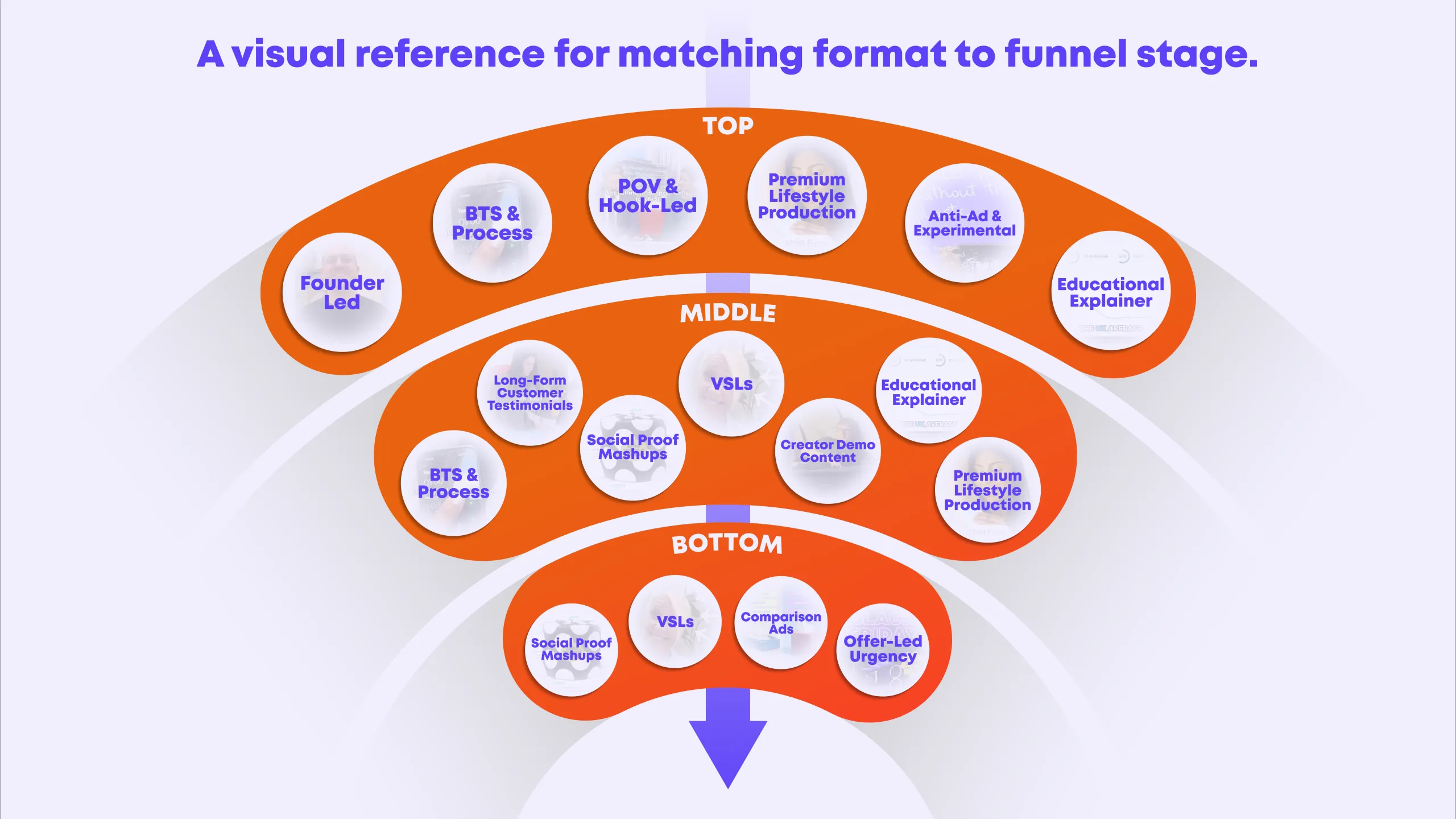
Match format to funnel stage. Founder stories, POV hooks, BTS content, lifestyle production, and anti-ad creative belong at the top. Testimonials, explainers, creator demos, and social proof mashups sit in the middle. VSLs, comparison ads, and offer-led creative close at the bottom. Running a conversion format to a cold audience wastes budget and produces misleading data.
Match format to persona. The same product can legitimately speak to four or five distinct personas. A customer who discovered you through a friend needs different creative to one who found you through search. Matching the format to the person, not just the funnel stage, is where the real gains are. This was central to the Who Gives A Crap approach: mapping specific creators and formats to specific personas, rather than treating all audiences as interchangeable.
Build variety into your creative calendar. Format diversity isn't something you achieve in one campaign. Creative fatigue is accelerating: on accounts spending meaningfully, a concept can exhaust its addressable audience within days. The brands that stay ahead of it aren't producing more of the same. They're rotating more kinds of creative, consistently.
Don't neglect lo-fi. The temptation for premium brands is to weight their library towards hi-fi production. The data doesn't support that instinct. An analysis of over $100 million in top-spending DTC ads found that 42% were lo-fi, shot on an iPhone with minimal editing. The best-performing libraries have both, in genuine proportion.
How We Can Help
Building a creative system that actually covers the full format range is where most brands get stuck. It's a production challenge, a strategic one, and a quality control problem, often all at the same time.
That's the problem we're built to solve. We work with DTC brands to design, produce, and iterate across all twelve formats, so creative diversity becomes something you can sustain month to month rather than a one-off push.
If you're looking to scale creative without sacrificing quality or consistency, we'd love to hear about what you're working on.
Sources
- Meta Performance 5 Framework, "Creative diversification drives 32% increased efficiency and 8% incremental reach," reported in Adweek, 2022. adweek.com
- Meta Engineering Blog, "Meta Andromeda: Supercharging Advantage+ automation with the next-gen personalised ads retrieval engine," December 2024. engineering.fb.com
- Motion App, "2025 Ad Creative & Creative Strategy Trends": analysis of $100M+ in top-spending DTC ads. motionapp.com
- Nielsen and Nielsen Catalina Solutions, "When It Comes to Advertising Effectiveness, What Is Key?": meta-analysis of nearly 500 CPG campaigns, 2017. nielsen.com

Subscribe to our newsletter

More blog posts
See All.webp)


.webp)

.jpg)


%20v6%20alt.jpg)
