
What Creative Diversity Actually Means (And How to Implement It)
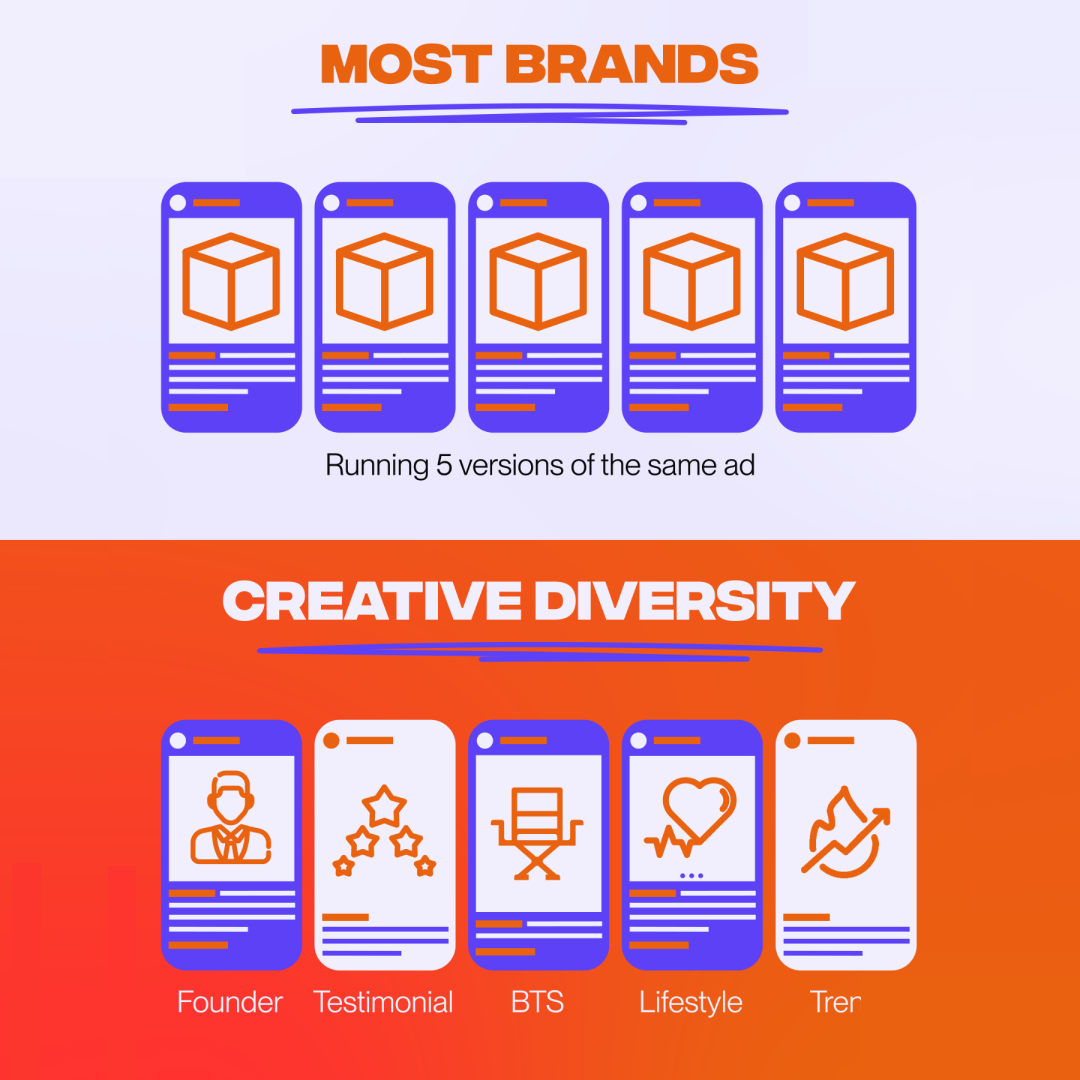
Your ad account probably has fifty ads and three ideas.
Not because your team is not working hard. Because the brief keeps producing the same concept in different wrappers. Different thumbnails. Different headlines. Different creators saying the same thing. Meta groups all of it together and serves it to the same narrow pool of people, over and over, until the frequency climbs and the returns fall.
That is not a media problem. It is a creative problem. And it starts at the definition.
Most brands treat creative diversity as a volume target. Make more ads, run more variations, test more combinations. But volume without genuine difference is just noise with a higher production bill. What the platform rewards, and what actually unlocks new reach, is conceptual originality: ads that are meaningfully distinct from each other in format, narrative, persona, and tone.
This article breaks down what that actually looks like, why it matters more than it ever has, and how to build a system that produces it consistently.
Why Creative Diversity Has Become So Important
For a long time, targeting was the primary lever on Meta. You could take one strong ad, build a tightly segmented audience, and make it work.
That model has broken down.
Meta's Andromeda update, which completed its global rollout in late 2025, represents the most significant overhaul of Meta's ad delivery system since Advantage+ launched in 2022. The platform has moved from an audience-first system to a creative-first one. Instead of asking who should see this ad, Andromeda now asks which ad should this person see.
The algorithm evaluates the semantic and visual signals inside your creative, then matches each individual user to the ad most likely to resonate with them. The more distinct your creatives are from one another, the more people the system can effectively reach.
If your creatives all look and feel the same, Andromeda has very little to work with. It clusters them together and delivers them to the same narrow group. Performance plateaus. Fatigue kicks in faster.
Charlie Bowes-Lyon, founder of Wild, put it well: advertisers focused on "making effective creative, in varying styles and optimising each style to the different stages of the funnel with proper test and learn approaches, should be able to seek out strong results at high spend levels." That framing is precisely right. Diversity isn't just about having more ads. It's about covering more territory.
Meta's own early data suggests correctly structured campaigns with diverse creative see an 8 to 10% uplift in results on average. The question is: what does diverse actually mean?
Part 1: Visual Diversity
Visual diversity is about making sure your ads look different from one another at a glance.
Not just slightly different. Meaningfully, obviously different.
A useful test here is what we call the squint test. Pull up your active ad library and squint at it. If everything blurs into one homogenous set of content, you have a visual diversity problem. If each ad reads as visually distinct, even at a glance, you're in a much better position.
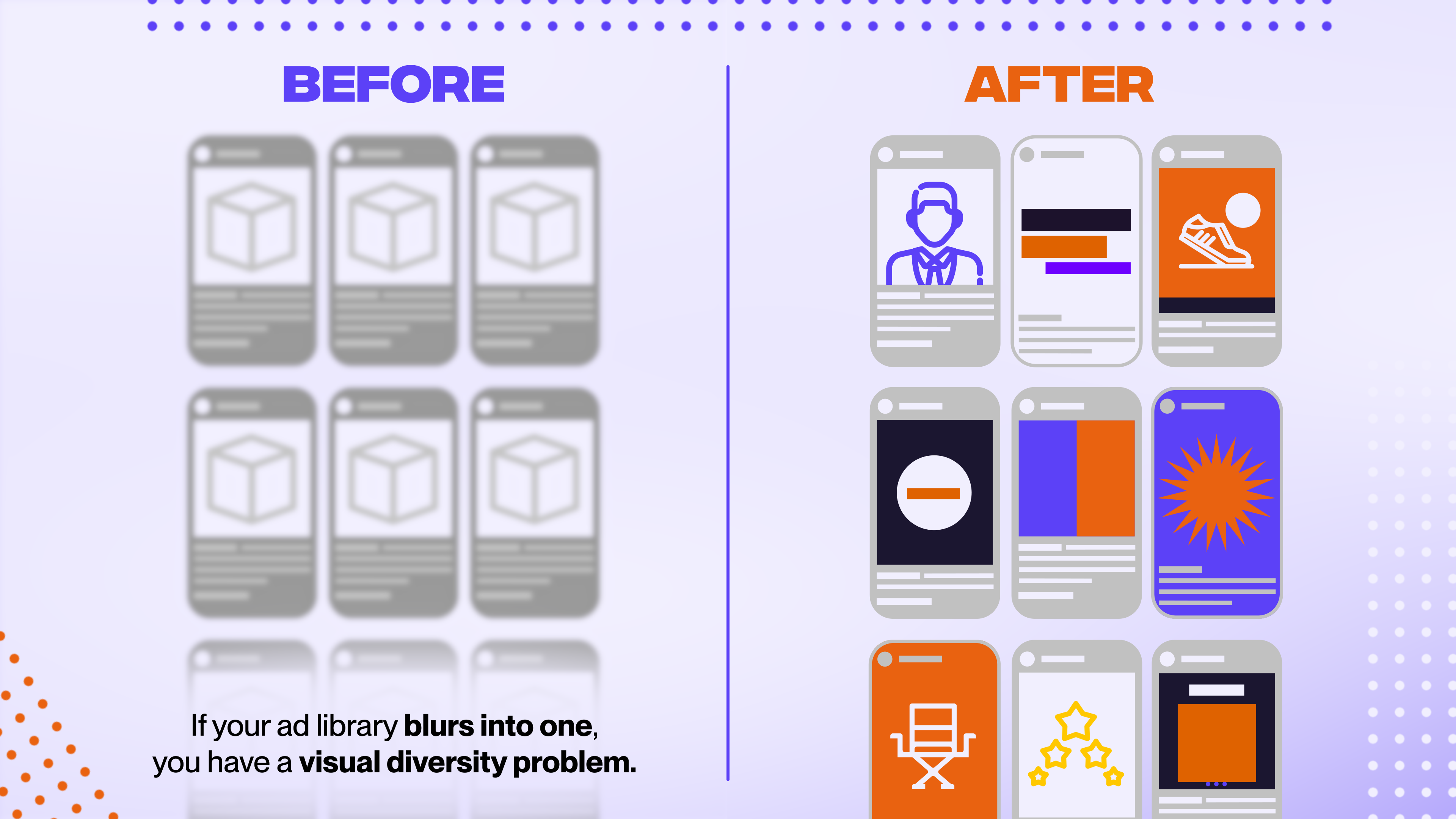
Here's what visual diversity looks like in practice.
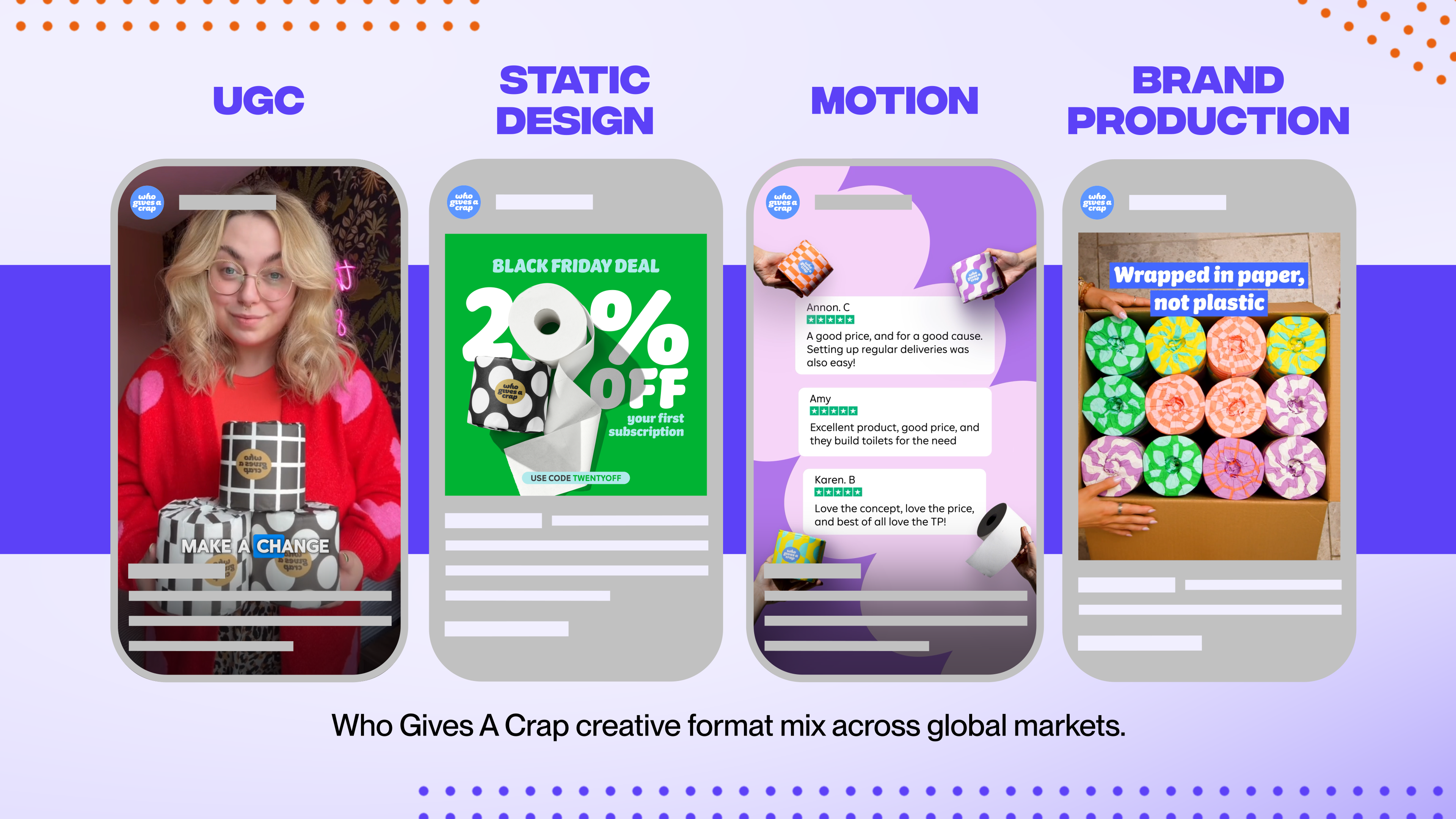
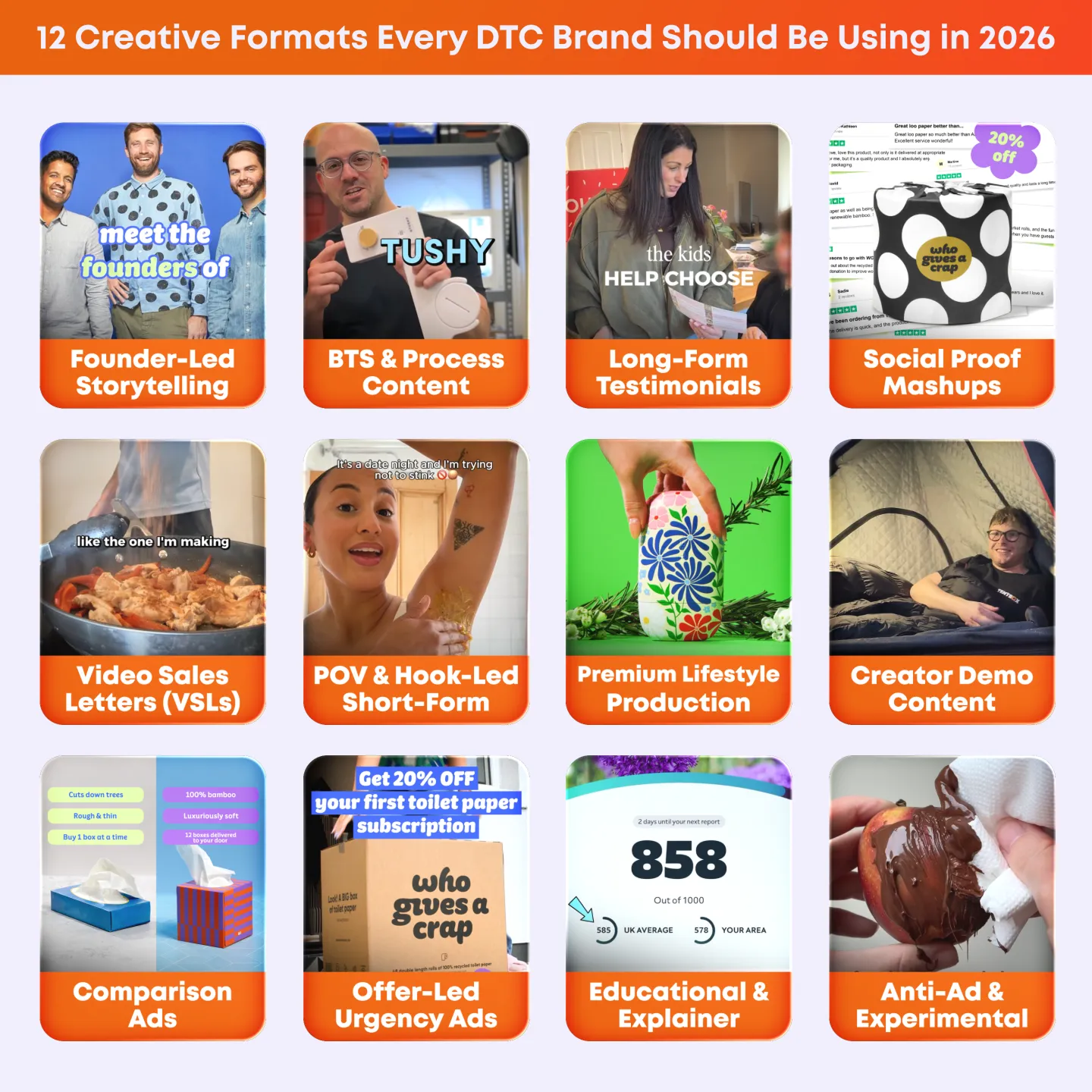
Format variety. Creator-led UGC, static design, motion creative, and branded production content will all look and feel different from one another. Running across all four gives the algorithm genuinely different signals to work with. Most agencies focus on one or two. Covering all four from the start builds a much richer library, and it's rare to find a single partner that can deliver all of them properly.
Colour and aesthetic treatment. Vibrant, saturated palettes versus muted, natural tones. Bold text overlays versus clean product-focused compositions. Busy lifestyle imagery versus stripped-back minimalism. These are all visually distinct and serve different placements and audiences.
Lo-fi versus hi-fi. Polished branded content and raw creator-style footage will look different to the algorithm and to the audience. Both have a place. Worth knowing: analysis of over $100 million in top-spending DTC ads found that 42% were lo-fi, shot on an iPhone with minimal editing. A library that only has hi-fi is limiting its reach and leaving some of its best-performing territory unexplored.
The ugly ad. Some of the best-performing creative in paid social looks intentionally unpolished. Raw cuts, text-heavy screens, direct-to-camera talking heads. These contrast sharply with slick branded content and attract attention precisely because they feel out of place in a feed full of beautiful production.
The goal of visual diversity is not aesthetic chaos. It's making sure that if someone looked at your ad library, they wouldn't mistake multiple ads for the same piece of content.
Part 2: Conceptual Diversity
Visual diversity is about how your ads look. Conceptual diversity is about what they say and how they say it.
This is the part most brands miss. And it's the part Andromeda responds to most strongly.
Conceptual diversity means using genuinely different narrative frameworks and messaging approaches across your creative. Not the same story told in different visual wrappers.
Narrative frameworks. Problem, agitate, solution is probably the most commonly used framework in DTC performance creative. It works. But if every ad in your library is structured the same way, you're reaching the same type of person each time. Adding tutorials, product-first demos, social proof compilations, founder stories, trend-led content, and long-form VSL formats into the mix means the algorithm has completely different content to match to completely different users.
Content length. A two-to-four-minute VSSL (video sales letter) and a six-second POV hook are reaching fundamentally different people in fundamentally different mindsets. Your library needs both. Brands that only produce 30-to-60-second ads are leaving a significant amount of reach on the table.
Personas and angles. This is where a lot of the real work happens. The same product can be marketed through completely different lenses: a pain point for one type of customer, an aspiration for another, a practical convenience for a third. Each of these angles speaks to a different person. When you build creative around specific personas and the distinct problems they have, Andromeda can match those ads to those people with much greater precision. Ads built around different awareness stages add another layer of conceptual diversity on top of that.
Tone and voice. Authoritative and educational versus conversational and relatable versus humorous and culturally aware. The same product can legitimately live in all three registers. Each one will resonate with a different segment of your audience. Analysis of the highest-spending DTC advertisers found that 25% used humour in their creative, compared to just 14% across the market as a whole. The brands spending the most have figured this out. Most brands are still waiting for permission to try it.
The test for conceptual diversity is this: if you read the scripts of your five most recent ads back to back, could you tell them apart? If they all follow the same structure, hit the same beats, and make the same argument, you have a conceptual diversity problem even if they look visually different.
Part 3: What It Looks Like in Practice
Who Gives A Crap is a useful example of what systematic creative diversity actually delivers.
The brand faces a challenge most DTC brands recognise: a highly commoditised category (toilet paper), a distinctive tone of voice built on humour and purpose, and a real risk that scaling paid social could erode both.
Working with Aura Ads, they built a Creative Operating System rather than a traditional ad library. That system explored the brand's value proposition across multiple conceptual angles, sustainability credentials, product quality, subscription convenience, and irreverent humour, rather than treating paid social as a single channel requiring a single message. Creator partnerships were mapped to specific target personas, so the algorithm had genuinely different content to serve to genuinely different people across the UK, US, and Australia.
The results reflect what systematic creative diversity, rather than creative volume, actually produces. Over the course of the partnership: 4,300+ ads produced across three global markets. A 21% concept win rate, meaning roughly one in five concepts tested became a scaled performer. A 72% increase in Meta media spend supported by that creative output. And 70% growth in the UK market.
What that win rate tells you is also worth noting. At 21%, roughly four out of five concepts didn't scale. But because each concept was genuinely distinct, different angles, different personas, different formats, every test generated real signal. The learnings compounded. The creative engine improved continuously rather than plateauing.
That's what a diverse library does that a high-volume library can't.
HelloFresh shows what this looks like at scale. Working with Aura across Meta and TikTok, the brief was not just to produce more ads. It was to build a creative testing engine: a closed loop between hypotheses, production, validation, and learning. Each sprint tested three to five distinct buying angles spanning convenience, health, cost-saving, and variety. Over 100 unique creators were deployed across the campaign, each delivering platform-native content designed for authenticity. The result was 4,300+ ads tested in 12 months, a 134% increase in Meta spend, and a 251% increase on TikTok. The system got smarter with every cycle because the creative was genuinely diverse enough to generate directional signal, not just volume.
Part 4: How to Actually Implement It
Understanding visual and conceptual diversity is one thing. Building a system to produce it consistently is another.
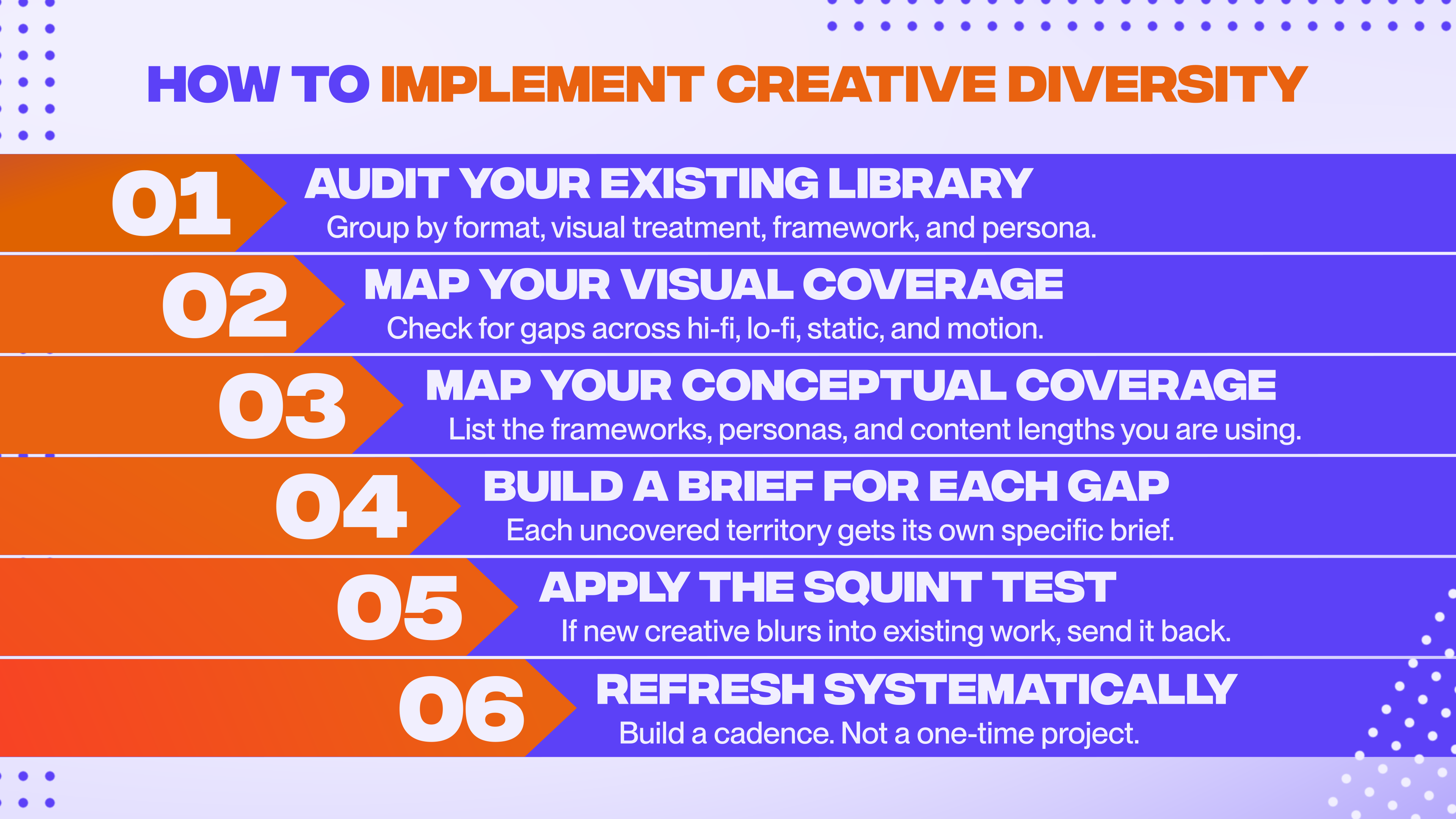
Here is a practical framework for getting both in place.
Step 1: Audit your existing library. Pull all your active ads and group them by format, visual treatment, framework, and persona. Most brands find they have heavy concentration in one or two buckets and nothing in the others. That audit tells you exactly where your gaps are.
Step 2: Map your visual coverage. Check you have active creative across at least three or four distinct visual territories: hi-fi branded content, lo-fi creator content, static design, and motion. If you're missing one or two, that's where to build next.
Step 3: Map your conceptual coverage. List the key frameworks you're using, the personas you're speaking to, and the content lengths in your library. Identify which are missing. A brand that only has problem-agitate-solution content in 30-to-60-second format is only covering a fraction of the available conceptual territory.
Step 4: Build a brief for each gap. Each conceptual and visual territory you've identified should have its own brief. Not a generic "make a creator ad" brief. A specific brief that defines the persona, the angle, the framework, the tone, and the visual treatment. The brief is what ensures creative diversity doesn't become creative chaos.
Step 5: The squint test. Once new creative is produced, apply the squint test. Open the full library. Squint. If the new ads blur into the existing ones, revisit the brief. If they read as genuinely distinct, they're ready to test.
Step 6: Refresh systematically. Creative diversity is not a one-time project. Under Andromeda, ad fatigue is accelerating. Build a production cadence that keeps new formats, frameworks, and angles rotating into the library on a regular basis. A static library is a fatiguing library.
A Note on Volume vs Diversity
One thing worth clarifying before we finish.
Creative diversity is not the same as creative volume.
More ads do not equal more diversity. Twenty versions of the same concept, shot in slightly different ways, will be grouped together by Andromeda and delivered to the same narrow pool of users.
The platform can detect when creatives are semantically and visually similar. Similar ads compete against each other. They don't compound.
What matters is the number of meaningfully distinct creative territories you're covering, not the total number of ads in your library. Eight genuinely different ads will almost always outperform forty near-identical variations.
Build wide first, then build deep.
How We Can Help
The brands building the strongest creative libraries rarely rely on a single format. Creator-led content, static design, motion and full-scale production each play a different role in expanding creative territory. Since 2020, we've built our Creative Operating System around bringing all four together under one testing framework.
Rather than simply producing more ads, we help DTC brands build structured creative testing systems that uncover new concepts, validate winning ideas and continuously expand the creative territories available to Meta's algorithm.
That approach has helped Who Gives A Crap produce more than 4,300 ads across three global markets while supporting 70% UK market growth. It helped HelloFresh build a creative testing engine that enabled a 134% increase in Meta spend and a 251% increase in TikTok spend. It helped TUSHY test 223 new creatives in 90 days, delivering a 12% increase in ROAS and a 9.2% reduction in cost per purchase, while PizzaExpress reduced its cost per booking by 20% by making creator-led creative a core acquisition channel.
Creative volume isn't the objective. Creative diversity is. And achieving it consistently requires more than producing more ads. It requires a system. Explore our case studies below to see how leading DTC brands are putting that system into practice.
Related reading:
We are Aura Ads, a specialist performance creative agency for DTC and eCommerce brands. We help clients sell more online and grow at scale with data-driven creative delivered on a monthly basis.
For more insights from our team, check out our blog.
Sources
- Meta Engineering Blog, "Meta Andromeda: Supercharging Advantage+ automation with the next-gen personalised ads retrieval engine," December 2024. engineering.fb.com
- Nielsen and Nielsen Catalina Solutions, "When It Comes to Advertising Effectiveness, What Is Key?", meta-analysis of nearly 500 CPG campaigns, 2017. nielsen.com
- Motion App, "2025 Ad Creative & Creative Strategy Trends", analysis of $100M+ in top-spending DTC ads. motionapp.com
- Meta Performance 5 framework, "Creative Diversification Drives 32% Increased Efficiency and 8% Incremental Reach," reported in Adweek, 2022.
- Charlie Bowes-Lyon (Wild), quoted in Aura Ads, "Projections & Insights from the UK's Most Disruptive DTC Leaders," 2024. auraads.co

Subscribe to our newsletter

More blog posts
See All


.jpg)


%20v6%20alt.jpg)
